The Two Retrieval Modes in ChatGPT Optimization
ChatGPT draws on two knowledge sources. Parametric knowledge is what the model learned during training: brand associations, product descriptions, and category relationships stored in its weights and retrieved from memory. Retrieval-augmented generation (RAG) is live search: ChatGPT Search queries Bing in real time and retrieves current URLs to synthesize answers for queries that require fresh or specific information.
Both matter for a complete optimization strategy, but they respond to different tactics. Parametric visibility builds over months through sustained third-party consensus: your brand appearing across industry publications, review platforms, and structured knowledge bases. RAG visibility is more immediate and more directly measurable. The four stages below address both, with the most actionable detail on RAG because that is where content and distribution decisions have the clearest causal effect.
Stage 1: The Bing Prerequisite for ChatGPT Optimization
The most important first step is confirming your Bing ranking for target queries. Seer Interactive's analysis of 500+ SearchGPT citations found that 87% of them match Bing's top organic results, compared with 56% for Google. ChatGPT Search is a Bing-powered product.
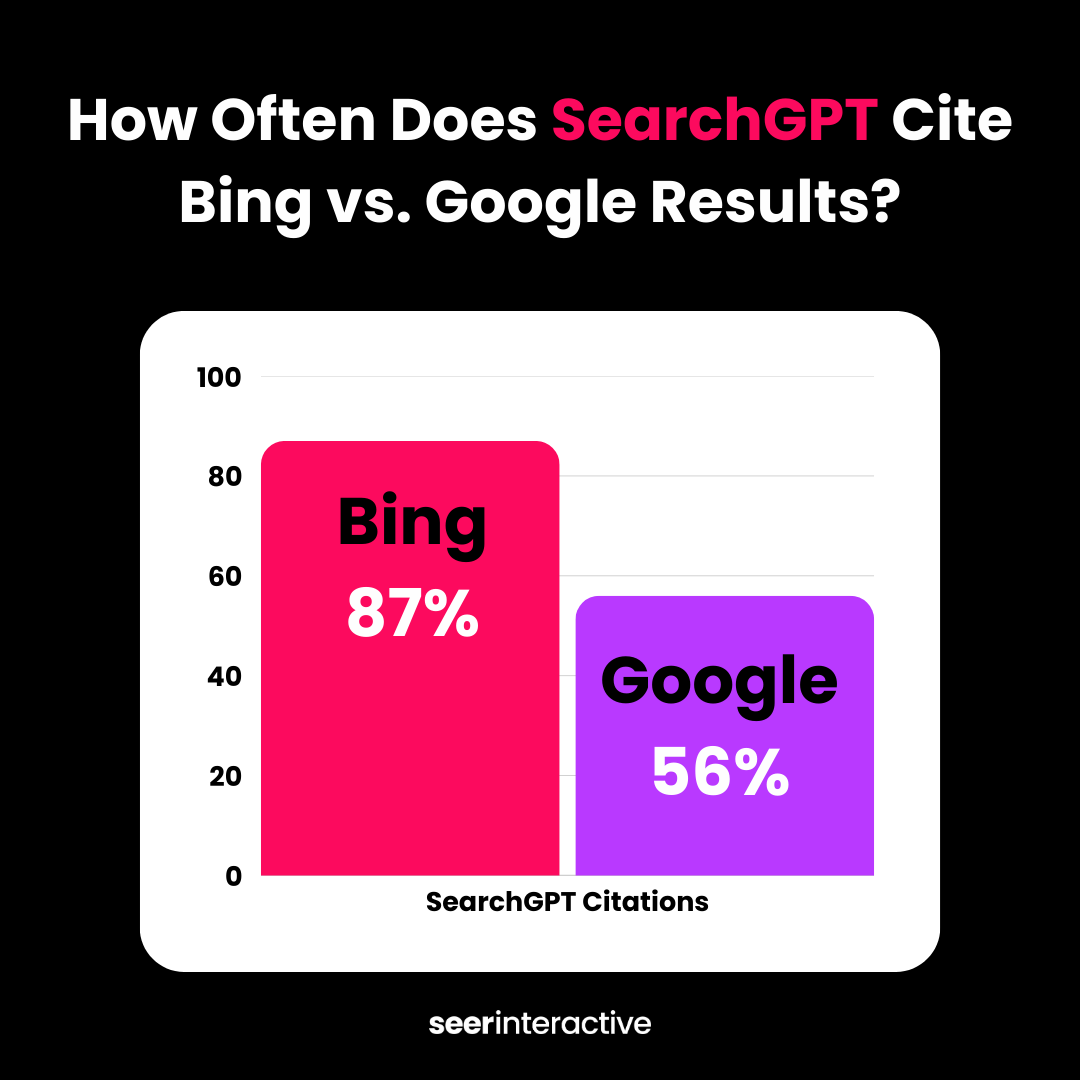
Ranking on Google is necessary but not sufficient. Brands that have invested exclusively in Google-oriented SEO often find their ChatGPT visibility is weaker than their Google performance suggests. A technical audit of your Bing index coverage, Bing Webmaster Tools setup, and Bing-specific performance for target keywords is a prerequisite before other optimization steps make sense.
One structural complexity: ChatGPT does not search the user's exact query. It decomposes the prompt into multiple sub-queries, each targeting a different facet of the answer. Your content must match those sub-queries, not the surface question. A practical approach is to run your target prompts through ChatGPT and note which follow-up questions or search terms surface, then restructure your content hierarchy to answer those specific questions.
On crawlability: a common concern is whether blocking GPTBot, the training data crawler, prevents ChatGPT from citing your content. It does not. ChatGPT Search retrieves live content through Bing's index, not through the training data pipeline. Ahrefs' research on ChatGPT citation patterns confirms that robots.txt restrictions for training crawlers do not affect live search citation rates.
Stage 2: Structure Content to Pass the Selection Gate
ChatGPT retrieves roughly 33 URLs per prompt and cites approximately 50% of them. Getting retrieved is the first gate; getting selected is the second. The SE Ranking study of 129,000 domains and 100,000 prompts and Ahrefs' analysis of 1.4 million prompts identify the content signals that raise selection probability:
| Content signal | Higher-performance threshold | Citation impact |
|---|---|---|
| Heading type | Question-based (H2/H3) | 18.0% citation rate vs. 8.9% declarative |
| Statistical density | 19+ data points per page | 5.4 avg. citations vs. 2.8 minimal |
| Expert quotes | Present | 4.1 avg. citations vs. 2.4 absent |
| Language style | Definitive ("X is...") | 36.2% citation rate vs. 20.2% hedged |
| Content length | Over 2,900 words | 5.1 avg. citations vs. 3.2 under 800 words |
| Freshness | Updated within 3 months | 6.0 avg. citations vs. 3.6 outdated |
| Page speed (FCP) | Under 0.4 seconds | 6.7 avg. citations vs. 2.1 over 1.13s |
Sources: SE Ranking, Ahrefs
Two placement patterns from the Ahrefs data deserve attention. First, 44.2% of content that gets cited comes from the first 30% of the page. Your most citable claim, definition, or statistic should appear high up, not buried in the final sections. Second, 53% of cited passages hit the middle sentence of a paragraph. Structure key assertions as the central sentence of a three-sentence block.
Content freshness is a measurable factor, not a vague best practice. Ahrefs found ChatGPT prefers content that is, on average, 393 days fresher than what Google organic typically surfaces. Pages updated within the last three months receive 6.0 average citations in the SE Ranking data; outdated pages receive 3.6. For high-value keyword targets, quarterly content reviews are an operational SEO task.
A counter-intuitive finding from the SE Ranking study deserves specific attention: high keyword-to-URL semantic relevance correlates negatively with citation frequency. Pages with low relevance scores (0.00 to 0.57) averaged 6.4 citations; pages with high relevance (0.84 to 1.00) averaged 2.7. Keyword-dense URLs signal a promotional intent that the model discounts. Natural, descriptive URLs outperform over-optimized ones.
The Princeton GEO study (arXiv:2311.09735) reinforces these findings from an academic direction: adding statistics to content improved AI citation visibility by 41%, and adding source citations to content improved citation rates by 30%. Content structured like a reference source gets treated like one.
Stage 3: Build the Third-Party Authority That Gets You Named
Being cited and being named are not the same outcome, and the gap matters for brand building.
Semrush's June 2026 research on ghost citations found that 62% of AI citations are ghost citations: the URL appears in the sources panel, but the brand name never appears in the response text. ChatGPT is the most extreme case among major AI platforms: 87% citation rate, but only 20.7% brand mention rate. Gemini shows the opposite pattern: lower citation rates but brand name mentions in 83.7% of responses that include a citation. Getting your URL into ChatGPT's sources is a relatively low bar; getting your brand name spoken in the answer requires a different kind of signal.
Named mentions come from third-party consensus. The signals that produce them include:
- Review platform presence. Brands with profiles on established review platforms (Trustpilot, G2, Capterra depending on category) appear in ChatGPT answers at substantially higher rates than brands with no third-party review footprint. Review content feeds both parametric training and live search retrieval.
- Structured knowledge base entries. ChatGPT cross-references brand identity against Wikidata and Wikipedia when assembling answers about companies, products, and people. Wikidata entity entries are accessible to brands that do not meet Wikipedia's notability threshold and can be created and verified in a short period.
- YouTube channel presence. Ahrefs' citation analysis found YouTube channel presence has a correlation coefficient above 0.7 with AI visibility across platforms, making it the single strongest channel-level predictor in their dataset. Video content also generates the kind of third-party annotation (descriptions, transcripts, comments) that feeds parametric knowledge.
- Comparative query coverage. Semrush's data shows comparative queries generate 2.4x more brand name mentions than informational queries. Being named in credible "X vs. Y" or "best [category]" coverage in publications with genuine editorial standards accelerates parametric brand association at a rate that on-site content cannot match.
The entity signals behind third-party authority are covered in depth in our post on brand entity optimization for AI search. Platform mechanics for other AI search engines follow different patterns: how Perplexity selects sources and what content it prefers are detailed in our guide to optimizing for Perplexity AI.
Stage 4: Measure Visibility You Cannot See Directly
Free ChatGPT users generate no referrer data, so their sessions register as "Direct" in GA4 and AI-sourced traffic is undercounted in most reporting setups. Standard organic search dashboards give you no signal on whether ChatGPT is recommending your brand or your competitors.
A practical measurement stack combines three methods:
- Prompt polling. Construct a set of 20 to 40 target queries, run them through ChatGPT on a fixed weekly schedule, and record whether your brand appears, in what position, and whether the mention is named or a ghost citation.
- AI Share of Voice. Calculate the percentage of target prompts where your brand name appears in the response text. Track this weekly against your top two or three competitors. Share of Voice movement is more meaningful than raw citation counts because it captures relative position in a competitive set.
- Ghost citation tracking. Compare your domain's appearance in the sources panel against your brand-name appearances in the response text. The gap between those two figures is your ghost citation rate. A high ghost citation rate indicates your content is reaching retrieval but failing on third-party authority, and the remedy is earned media and review platform work, not on-site optimization.
For a complete framework including GA4 configuration for AI traffic attribution, see our guide on how to track brand mentions in AI search. If you want a baseline reading of where your brand stands across ChatGPT and other platforms before building out a measurement program, a free AI Visibility Report provides that starting snapshot.
Three Tactics That Do Not Improve ChatGPT Citations
The research record on ChatGPT citation signals is clear on what does not work, which matters because these tactics consume real resources:
- Schema markup. Ahrefs' analysis found no measurable impact of structured data markup on AI citation rates. ChatGPT does not parse schema as a citation selection signal.
- LLMs.txt files. A 2026 Ahrefs study found that 97% of LLMs.txt files receive zero visits from AI bots. The format has legitimate value for agentic developer tools that parse technical documentation, but it does not affect ChatGPT Search behavior.
- Keyword-dense URLs and titles. As the SE Ranking data shows, high keyword-to-URL semantic relevance correlates negatively with citation rates. Optimization tactics that make URLs and page titles more keyword-heavy are counterproductive for ChatGPT citation goals.
Timeline and What to Expect
Citation changes in ChatGPT take longer to register than on most other AI platforms. Perplexity typically reflects content and authority changes within 2 to 4 weeks. ChatGPT takes 6 to 12 weeks for most changes to register in responses. If your brand visibility is not moving after 12 weeks of effort, the bottleneck is usually third-party authority rather than on-site content.
The four stages above give you a working sequence: secure Bing rank for target queries, structure content for extraction, build the third-party signals that produce named mentions, and measure against stage-appropriate benchmarks.
Frequently asked questions
How long does it take to see results from ChatGPT optimization?
For live search (RAG-mode) citations, expect 6 to 12 weeks for most content and authority changes to register in ChatGPT responses. Perplexity responds faster, typically in 2 to 4 weeks. If visibility is not moving after 12 weeks of consistent optimization effort, the bottleneck is most often third-party authority signals rather than on-site content quality.
Does blocking GPTBot harm ChatGPT search visibility?
No. GPTBot is a training data crawler, separate from the Bing-based retrieval that ChatGPT Search uses for real-time responses. Ahrefs' research confirms that robots.txt restrictions for training crawlers do not appear to affect live search citation rates. Your Bing indexing status and content quality are the relevant factors, not training crawler access.
What is a ghost citation and why does it matter?
A ghost citation occurs when your URL appears in ChatGPT's sources panel but your brand name does not appear in the response text. Semrush's June 2026 research found 62% of all AI citations are ghost citations, and ChatGPT's brand mention rate is only 20.7%. Ghost citations can drive click traffic but they do not build brand recall in AI responses. Closing the gap requires third-party authority work (review platforms, earned media, knowledge base entries), not changes to on-site content.
Does ChatGPT use Google or Bing for search?
ChatGPT Search uses Bing for real-time retrieval. Seer Interactive's citation analysis found 87% of SearchGPT citations match Bing's top organic results, compared with 56% for Google. Standard Google SEO is insufficient on its own: Bing indexing, Bing Webmaster Tools setup, and Bing-specific ranking for target queries are active prerequisites for ChatGPT search visibility.