How Perplexity decides which sources to cite
Perplexity runs on retrieval-augmented generation. When someone asks a question, it searches the live web, fetches a set of candidate pages, ranks the passages inside them for relevance to the question, and writes an answer that cites the strongest few. There is no static index position to climb. A page can be cited for one phrasing of a question and skipped for another, because the retrieval step rebuilds the candidate set every time.
Two things follow. First, the passage matters more than the page. Perplexity rarely reads a 2,000-word article end to end. It lifts the section that answers the question, so a buried answer loses to a clear one even on a weaker domain. Second, where citations land is concentrated. Ahrefs tracked 3.1 million US queries through its Brand Radar tool and found YouTube captured 32.4% of Perplexity citations and Reddit 16.6%, with Wikipedia third at 8.2% (Ahrefs, June 2026). That is the most concentrated top source of any assistant in the study.
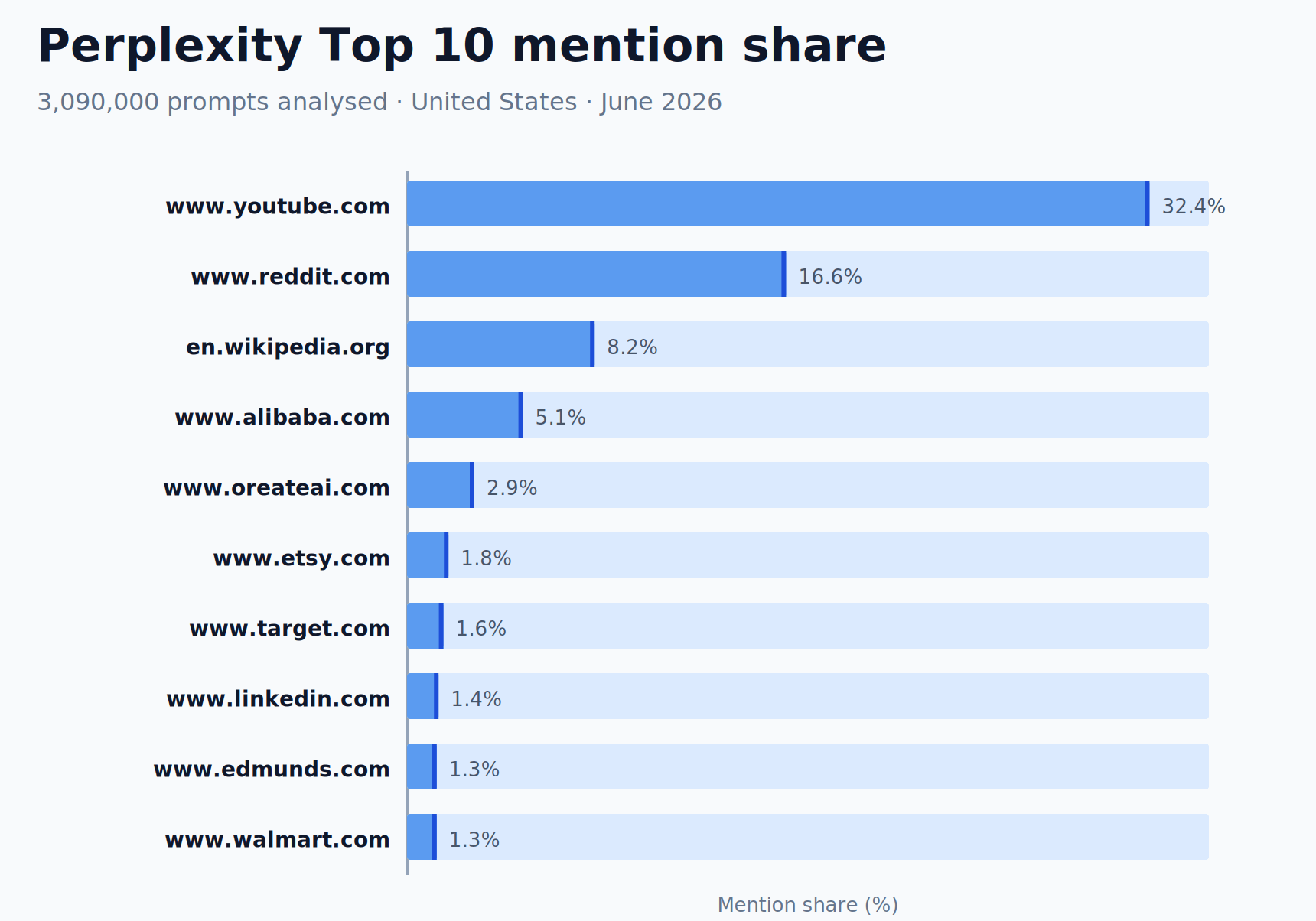
The pattern holds across other research. A Peec AI analysis of 30 million sources reported by Search Engine Land found Reddit, YouTube, and LinkedIn were the most-cited platforms across AI search engines, with Perplexity leaning on Reddit, LinkedIn, and G2 for B2B queries (Search Engine Land, March 2026). The takeaway is not that your own site cannot rank. It is that a single page is one candidate among many, and the platforms above sit in almost every candidate set.
The four question types Perplexity answers
Perplexity reads what kind of answer a query wants before it retrieves. A definition query and a "best tool for X" query trigger different source preferences and reward different formats. Map your content to the type you want to win rather than writing one generic page and hoping.
| Query type | What the user wants | Sources Perplexity favors | Format that gets cited |
|---|---|---|---|
| Factual | A definition, date, or number | Encyclopedic pages, official sites, primary data | One-sentence answer up top, then the supporting figure with its source |
| Comparative | Options weighed against each other | Reviews, forums, side-by-side pages | A comparison table with named criteria, not prose |
| Procedural | Steps to do something | How-to pages with explicit steps | A numbered list, one action per step |
| Opinion | A judgment or recommendation | Forums, review sites, named expert commentary | A clear stance with reasoning and a named author |
The practical move is to decide which type each target query belongs to, then build the page in that shape. If buyers ask Perplexity to compare options in your category, a wall of paragraphs will not get cited no matter how thorough it is, because the retrieval step is looking for a structured comparison. Give it the table.
How to optimize for Perplexity AI: a page blueprint
Once you know the question type, the build follows a consistent pattern. These are the elements that survive Perplexity's retrieval and reading steps.
- Make the page fetchable. Allow PerplexityBot in your robots file and keep load times low. A page Perplexity cannot crawl or render is never a candidate.
- Lead with the answer. Put a direct, self-contained answer in the first one or two sentences of each section, then expand. Aim for passages of 150 to 300 words that stand on their own without the rest of the page for context.
- One question per H2. Heading that mirrors the question, answer underneath. This makes the relevant passage easy to isolate.
- Use the format the query type rewards. Tables for comparative queries, numbered steps for procedural ones, a sourced figure for factual ones.
- Keep it current. Perplexity has a stronger recency bias than classic search. Date your updates and refresh statistics, because a stale page loses to a fresher one on time-sensitive topics.
- Make the entity legible. Consistent brand name, named author bylines, and clear organization details help Perplexity connect the page to a known entity. The same signals that get a brand surfaced in AI answers apply here, covered in our guide to getting your brand mentioned in AI answers.
None of these are tricks. They are the structure a careful editor would use anyway. Perplexity rewards them because they make a passage easy to read and easy to trust.
Earn presence on the sources Perplexity already trusts
Because citations concentrate on a few platforms, your own site is not the whole strategy. The same study that ranked YouTube and Reddit at the top also explains why so many brand citations come from places the brand does not own. We unpack that data in the most-cited domains in Google AI Overviews, and the platform mix for Perplexity is similar.
Treat these as places to be genuinely useful, not channels to spam:
- Reddit: Answer real questions in the subreddits where your buyers gather. Perplexity reads threads for opinion and comparative queries, and thin promotional comments get downvoted out of view.
- YouTube: A walkthrough or demonstration from a named expert carries signals that are hard to fake. For procedural and product queries, video earns citations text cannot.
- LinkedIn and G2: For B2B categories, profiles, posts, and review pages feed the comparative answers buyers ask for.
- Wikipedia and reference pages: For factual queries about your category or company, an accurate, well-sourced reference entry shapes what Perplexity treats as settled fact.
You will not control these pages, which is the point. Earned mentions from sources Perplexity trusts do more for citation share than another page on your own domain.
How to measure whether it is working
Keyword rankings will not tell you if Perplexity cites you, because there is no ranking to read. Build a fixed set of prompts your buyers would ask, run them on a schedule, and record whether your brand appears, in what position, and which source the citation came from. Watch citation share over time rather than any single answer, since retrieval varies run to run. Our framework for tracking brand mentions in AI search walks through the metrics and the prompt taxonomy.
If you want a baseline before you start, our free AI Visibility Report shows where your brand stands across Perplexity and the other assistants today, so you know which question types you already win and which you do not.
Frequently asked questions
Does Perplexity use Google rankings to choose sources?
Partly. Its retrieval step draws on web search, so pages that rank well are more likely to enter the candidate set. But ranking first does not guarantee a citation, because Perplexity then reads passages and cites the clearest answer. A lower-ranked page with a sharper answer can win the citation.
How long until optimization changes show up in Perplexity?
Faster than classic SEO in most cases. Perplexity retrieves live and favors fresh content, so a new or updated page can be picked up within days to a few weeks once it is crawlable and indexed. Earning citations on third-party platforms takes longer, since it depends on other people referencing you.
Does schema markup help with Perplexity citations?
Structured data helps machines parse your content and confirm entity details, which supports retrieval. It is not a standalone lever that forces a citation. A clear answer-first structure does more for getting cited than markup alone, so treat schema as support for good structure, not a substitute for it.
Do I have to be on Reddit to get cited by Perplexity?
No, but it helps for opinion and comparative queries, where Reddit is one of Perplexity's most-cited sources. The value comes from being genuinely helpful in the right communities. Promotional posting tends to get removed or downvoted, which removes the page from the candidate set.
Where to start
Pick the five questions your buyers most want answered, decide which type each one is, and rebuild those pages in the format that question type rewards. Confirm PerplexityBot can crawl them, lead each section with a self-contained answer, and keep the facts current. Then measure citation share on a fixed prompt set so you can see the format changes pay off, and look for the two or three trusted platforms where earning a mention puts you in front of buyers who are asking Perplexity instead of Google.