What an llms.txt file is
llms.txt is a plain Markdown file hosted at a site's root (yoursite.com/llms.txt), proposed by Mintlify in 2024 as a companion to robots.txt and sitemap.xml. It typically contains an H1 with the brand name, a short blockquote description, and a set of links grouped under headings like Docs, Guides, or Products. The idea was that a large language model reading a site could skip crawling the full HTML and instead read a compact, hand-curated summary written specifically for machines.
That premise assumes AI systems prefer a static manifest over the page content they already crawl and index. Two years into adoption, the data says they do not.
What Google says about llms.txt for AI search visibility
Google's guide to optimizing for generative AI features on Search addresses llms.txt directly. The documentation states: "You don't need to create new machine readable files, AI text files, markup, or Markdown to appear in Google Search (including its generative AI capabilities), as Google Search itself doesn't use them." It goes further on impact: "Doing so will neither harm nor help your site's visibility or rankings in Google Search, as Google Search ignores them." That guidance, published by Google, covers AI Overviews and AI Mode specifically, not only classic organic results.
This lines up with earlier public comments from Google's Search team comparing llms.txt to the deprecated keywords meta tag: a file webmasters write for themselves that the crawler on the other end never asked for and does not read.
What three 2026 studies found
Independent data backs Google's statement. Three separate research efforts, using different methodologies and different domain sets, arrived at the same conclusion.
| Study | Sample | Adoption rate | Finding |
|---|---|---|---|
| Ahrefs (June 2026) | 137,210 domains | 28% publish a valid file | 97% of files got zero requests in a month; no visibility uplift found |
| SE Ranking (Nov 2025) | ~300,000 domains | 10.13% publish a file | No correlation with citation frequency; removing the variable improved model accuracy |
| Google Search Central (2026 guidance) | N/A, official policy | N/A | Files are explicitly ignored by ranking systems, including AI features |
The adoption gap between the two studies (28% versus 10%) mostly reflects sample bias: Ahrefs pulled from its own customer base, which skews toward technically sophisticated sites more likely to have tried the file already. Neither study found that trying it paid off.
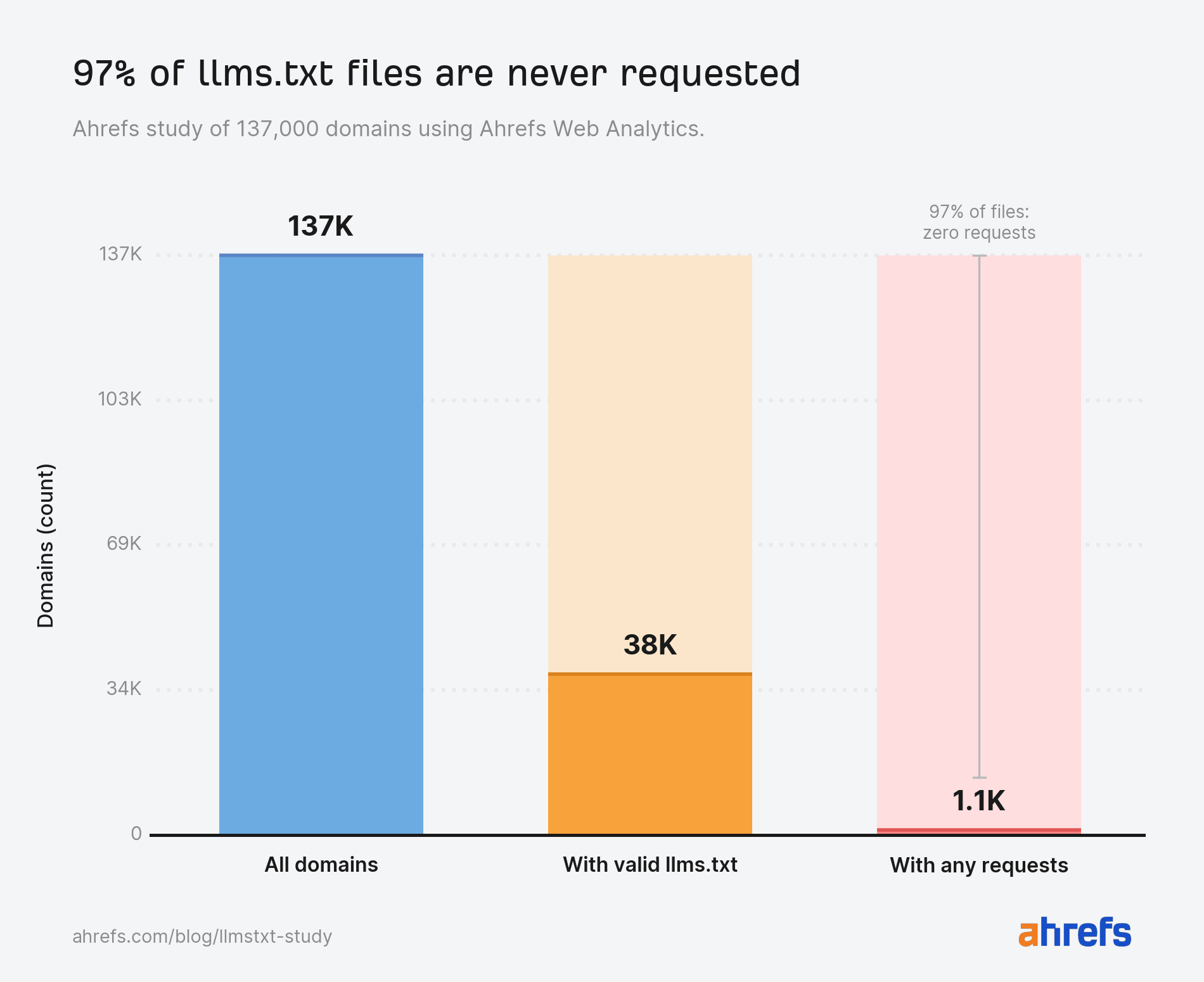
The more useful detail in the Ahrefs data is not the adoption number, it is who is requesting the file. Of the traffic that did reach an llms.txt file, 96% came from bots rather than humans, and within that bot traffic, 77% came from non-AI tools: SEO auditors, technology profilers, and general-purpose crawlers. Only 19.5% of requests came from named AI tools at all, and only 1.1% came from AI retrieval bots specifically (the category that would influence what gets cited in an answer). GPTBot led the AI crawlers, and Claude-Code, Anthropic's coding agent, outranked retrieval-focused bots like PerplexityBot.
Read plainly: the traffic hitting most llms.txt files is other people's audit tools checking whether the file is there, not the systems that decide whether a brand gets mentioned in an AI answer. That is a meaningfully different thing from AI search visibility, and it explains why adoption keeps climbing (agencies and audit tools flag the "gap") while citation data stays flat.
SE Ranking's study reached the same place from a different angle. Using XGBoost regression and SHAP analysis across roughly 300,000 domains, the team found that llms.txt presence added no predictive value for AI citation frequency, and that the model performed better once the variable was dropped entirely. Adoption in that dataset was also flat across traffic tiers: high-traffic sites (8.27%) adopted the file less often than mid-tier sites (10.54%), which is the opposite pattern you would expect if the tactic worked and stronger sites were capitalizing on it.
Why llms.txt doesn't move AI citations
The mechanism explains the data. Systems like ChatGPT's browsing tool, Perplexity, Google AI Overviews, and Claude's web search rely on live crawling and retrieval against the actual content of a page, using the same crawler infrastructure (GPTBot, ClaudeBot, PerplexityBot, Googlebot) they already run for indexing. A hand-written summary file sits outside that pipeline. It is not verified against the page it describes, it goes stale the moment a product page or pricing tier changes, and there is no reason for a retrieval system to trust an unverified self-report over the content it can crawl and check directly.
This is also why the file resists gaming less than site owners hope: an llms.txt that oversells a brand's positioning has no enforcement mechanism forcing the underlying page to back it up, so a system built to reduce hallucination risk has an incentive to ignore the kind of source Google described.
Where an llms.txt file might still earn its place
The one documented, if still experimental, use case sits outside search entirely. Chrome's Lighthouse tool added an Agentic Browsing category that checks a site's readiness for AI browser agents, not search rankings. Among other checks, it looks for an llms.txt file at the domain root as a discoverability signal, alongside accessibility tree integrity, layout stability, and WebMCP tool registration. Google's own documentation marks this category "experimental and based on proposed standards," which is a fair description of where the whole idea stands.
That distinction matters for planning. If the goal is AI search visibility, meaning citation in ChatGPT, Perplexity, Claude, or Google's AI features, an llms.txt file will not move it. If a product involves browser agents or MCP-based tool use navigating the site on a user's behalf (increasingly relevant for developer tools, SaaS dashboards, and enterprise software), maintaining a lightweight llms.txt costs little and may help an agent orient faster. Treat it as agent-experience scaffolding, not a marketing tactic, and size the investment accordingly: a few hours to draft and keep current, not a line item in a GEO retainer.
What drives AI search visibility instead
Every study cited here points the same direction: away from files and toward the signals AI systems already trust because they can verify them independently.
- Entity clarity. A consistent name, description, and sameAs profile (LinkedIn, Crunchbase, Wikidata, industry directories) that Google and other systems can cross-reference, covered in more depth in our guide to brand entity optimization for AI search.
- Third-party mentions and reviews. Independent coverage and reviews carry more weight than owned content because they cannot be authored by the brand itself, which is the practical framework in how to get your brand mentioned in AI answers.
- Direct-answer content. Pages structured to answer a specific question in the first sentence or two, the same pattern that wins featured snippets, tend to win AI citations for the same reason.
- Crawlable, current pages. If GPTBot, ClaudeBot, or PerplexityBot cannot reach or parse a page, no manifest file compensates for that; fix crawl access first.
- Structured data. Schema markup for Organization, Product, and FAQ content gives crawlers a machine-readable version of information that is already correct on the page, rather than a separate, unverified copy of it.
None of these are new advice. That is the point: the studies above are evidence that the fundamentals still carry the weight, and that a new file format does not substitute for them.
If it is unclear where a brand currently stands on these fundamentals, Elaventra's free AI Visibility Report benchmarks citation frequency across ChatGPT, Perplexity, Gemini, and Google AI Overviews, or book an AI Visibility Strategy Call to walk through what is driving (or blocking) citations for a specific brand.
Frequently asked questions
Does llms.txt help you get cited by ChatGPT?
No confirmed evidence supports this. Ahrefs' analysis of 137,210 domains found that llms.txt files received almost no requests from AI retrieval bots (1.1% of file traffic), and both the Ahrefs and SE Ranking studies found no correlation between having the file and citation frequency in AI answers, including ChatGPT.
Should I still create an llms.txt file in 2026?
It depends on the goal. For AI search visibility and citations, skip it: Google explicitly ignores it, and independent studies show no measurable benefit. For sites building agent-facing products or relying on browser agents and MCP tools, a simple llms.txt costs little to maintain and is checked by Chrome Lighthouse's experimental Agentic Browsing audit, so the small maintenance cost can pay off in that specific context.
What is the difference between llms.txt and robots.txt?
robots.txt is a directive file that tells crawlers what they are allowed or not allowed to access, and search engines and AI crawlers do respect it. llms.txt is a self-authored content summary intended to help an AI system understand a site faster, but unlike robots.txt, no major search or AI platform has confirmed it factors the file into crawling, indexing, or citation decisions.
Does llms.txt affect Google AI Overviews or AI Mode specifically?
No. Google's AI optimization guide names AI Overviews and AI Mode directly when stating that machine-readable files like llms.txt are ignored and have no effect, positive or negative, on visibility within those features.
llms.txt is not a scam and it is not dangerous to publish. It is not an AI search visibility tactic, based on Google's own documentation and two independent studies covering nearly half a million domains. Brands chasing AI citations get more return from entity clarity, earned third-party mentions, and content built to answer a question directly than from any new file format promising a shortcut.