What the 2026 Zero-Click Search Data Shows
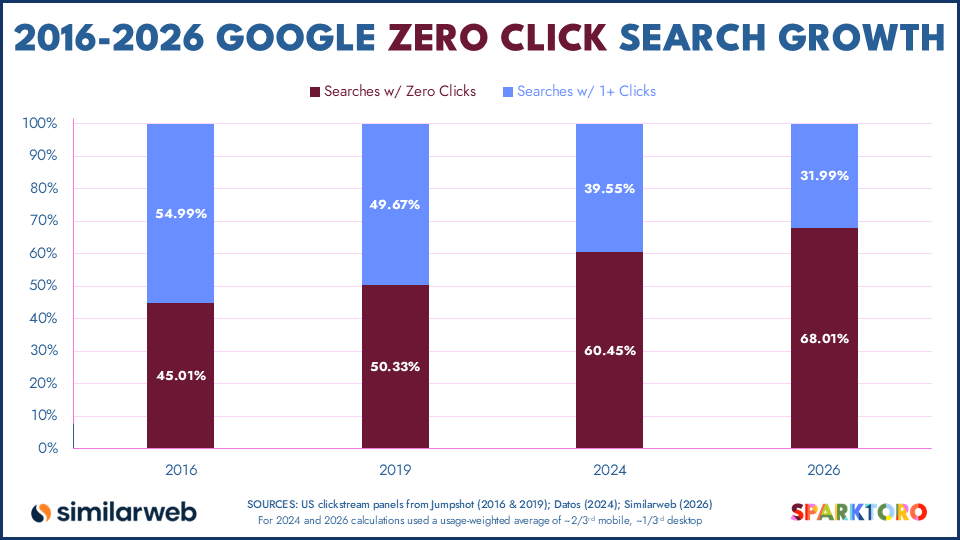
Fishkin's June 8 study draws on Similarweb's US desktop and mobile web clickstream panel. The finding: of every 1,000 US Google searches, only 276 clicks now flow to external websites. In 2024 that figure was 374. That is a 26% reduction in two years, and the primary driver is not one single feature but the compounding effect of Google building more answers directly into the results page.
AI Overviews are the sharpest contributor. The SparkToro analysis reports that AI Overviews appear on more than 20% of all Google searches and reduce click-through rate by nearly 60% wherever they appear. More queries triggering AI Overviews, each one suppressing click-through sharply, is the core mechanism behind the trend.
Fishkin also notes that the dataset excludes Google's dedicated mobile app, where zero-click behavior runs higher than on the web. The actual share of searches that never reach an external site is likely above the reported 68%.
The AI Mode Multiplier
Google AI Mode adds a separate and compounding dimension to the zero-click picture. In its official Google I/O 2026 announcement published May 19, Google confirmed that AI Mode has surpassed one billion monthly users in its first year of operation, with "queries more than doubling every quarter since launch." AI Mode delivers extended, conversational, multi-source answers and supports follow-up questions without the user ever navigating away from Google.
The same announcement introduced information agents: background AI systems for Google AI Pro and Ultra subscribers that reason continuously across blogs, news posts, social content, and real-time data on finance, shopping, and sports. These agents do not wait for a query. They monitor the web around the clock and surface updates when tracked content changes. The rollout to a broader user base is scheduled for summer 2026 and is already underway for premium subscribers.
For brands, the combination of AI Mode and background information agents means that brand research, category exploration, and competitive comparison are increasingly happening inside Google's interface, without any visit to a brand website appearing in analytics. A buyer can read an AI Mode answer comparing three vendors in your category, form a preference, and move to the shortlist stage without leaving a single data point in your GA4.
Why Traffic Metrics Are Now an Incomplete Proxy
Most marketing measurement systems were built on a foundational assumption: influence is trackable through visits. A session arrives, a source is attributed, a conversion is credited. That model functions when users leave Google and reach a brand domain. At 68% zero-click rate, the majority of brand-relevant search activity does not produce a visit.
A buyer searching for the best solution in your category may read an AI Mode answer that names three alternatives, summarizes their positioning, and describes pricing ranges, then close the tab or navigate directly to one of the named brands. Your brand either appeared in that AI answer or it did not. Your GA4 shows nothing either way.
This creates a gap between actual brand influence from search and measured brand influence from search. Brands with strong AI visibility may be generating substantial consideration while seeing flat or declining organic traffic. Brands absent from AI answers are being excluded from consideration with no visible signal in their dashboards.
| Metric | Traffic-based approach | AI visibility approach |
|---|---|---|
| Primary KPI | Organic sessions from Google | Citation rate in AI-generated answers |
| Primary tool | GA4 / Search Console | Prompt monitoring, AI tracking platforms |
| Coverage | Clicks that reached your domain | All queries where your brand was referenced |
| Blind spot | Zero-click AI-driven discovery | Requires systematic prompt sampling to operate |
| Competitive benchmark | Keyword rankings | Share of voice in AI answers by query category |
Three Adjustments for Brand Visibility Strategy
Reframe the primary search KPI
Organic traffic from Google retains value as a signal of ranking health and captures users who chose to click. But for categories where AI Overviews or AI Mode answers are common, which covers most informational queries and a growing share of commercial ones, traffic is an incomplete signal of brand influence in search. Treating AI citation rate as a parallel metric gives you a more complete picture of whether search is working for your brand. The measurement framework for tracking brand mentions in AI search describes how to set up this tracking systematically, including prompt taxonomy, platform coverage, and frequency.
Write content for AI extraction, not only for ranking
AI Overviews and AI Mode extract passages from indexed pages. Content written as dense narrative prose is harder for extraction models to use cleanly. Pages that open each section with a direct answer, use short paragraphs that each contain a self-contained claim, include comparison tables, and structure FAQs with specific question headings as H3s give AI systems far more to cite. The ranking goal and the extraction goal overlap substantially, but they differ in emphasis. In a 68% zero-click environment, extraction visibility is the more direct measure of whether a given piece of content is generating brand awareness in search.
Build the third-party mention layer
AI Overviews and AI Mode draw from multiple sources per answer. Being cited requires appearing in the sources those systems index and trust: trade publications, analyst reports, review platforms, comparison sites, and news coverage. This is distinct from traditional link building. The goal is not the link itself but the mention in a context that AI systems treat as authoritative for your category. A product featured in a respected industry comparison guide, named in a Gartner or Forrester brief, or discussed in a trade press round-up carries far more weight in AI extraction than a standard backlink in a generic directory. The signals that matter most, and how to strengthen them, are covered in the brand entity optimization for AI search guide.
If you want to see where your brand currently stands across all three dimensions, an AI visibility audit gives you a structured picture: current citation rate across platforms, where competitors are being named in your place, and which content and third-party mention gaps are most consequential.
Frequently Asked Questions
Does Google zero-click search mean SEO is dead?
No. AI Overviews and AI Mode draw predominantly from pages that rank in the top organic results, so ranking remains a prerequisite for being cited. The objective shifts: instead of optimizing primarily to earn clicks, brands optimize to earn extraction, meaning their content appears inside AI-generated answers whether or not the user clicks through. The two goals are complementary, not contradictory.
How do I measure brand visibility if traffic data no longer captures AI-driven discovery?
Run a structured prompt monitoring program: define a set of queries representative of how buyers in your category search, run them against Google AI Mode, Google AI Overviews, Perplexity, and ChatGPT on a consistent schedule, and record citation rates and brand mention framing. This produces a share-of-voice metric for AI-driven discovery that traffic data cannot. The AI search brand tracking guide covers the full methodology, including how to categorize queries and what to measure per platform.
Which query types generate the most zero-click behavior?
Informational and navigational queries generate the highest zero-click rates because AI Overviews answer them directly inside the results page. Commercial queries, where users intend to visit a destination to purchase or sign up, retain comparatively higher click-through rates. The SparkToro study reports that AI Overviews appear on more than 20% of all queries and cut CTR by nearly 60% wherever they appear, so the commercial category is also affected, particularly for research-heavy purchase decisions.
What content format performs best in AI Overviews and AI Mode?
Answer-first, structured content performs best. Opening sentences that deliver a direct definition or summary of the topic, short paragraphs that each contain a complete, standalone claim, comparison tables, and FAQ sections with H3 question headings all increase the probability that AI systems will extract and cite your content. Pages written primarily for keyword density or heading frequency tend to underperform in extraction relative to pages optimized for clarity and self-containment.
The SparkToro data makes the direction concrete: 276 clicks per 1,000 searches is the new baseline, down from 374 two years ago. The brands building durable search-driven awareness right now are those treating AI citation as the primary output of their search strategy rather than a secondary benefit of organic traffic.
To understand where your brand stands today, the free AI Visibility Report provides a structured baseline across the major AI platforms. If you want to discuss what that data means for your specific category and competitive position, an AI Visibility Strategy Call is the starting point.